
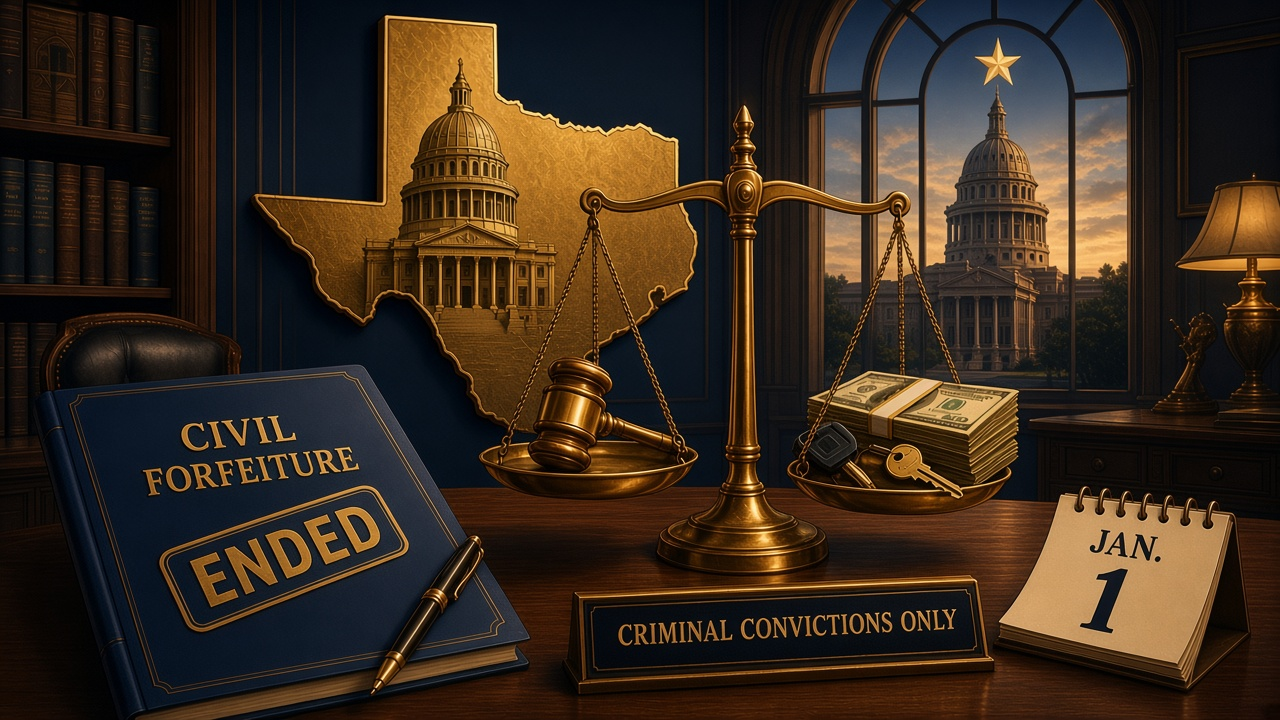
TEXAS COMPTROLLER: Comptroller Huffines Ends Civil Asset Forfeiture at the Comptroller's Office
The Texas Comptroller says its office is ending civil asset forfeiture, the latest of several Don Huffines moves before Sarah Eckhardt takes office Jan. 1. She asked him in a Nov. 9 letter to pause rule changes; he refused. What is confirmed and what is not.
AI-written summary of an official press release from the Texas Comptroller of Public Accounts, November 19, 2026. Read the original: the Comptroller's news release. This is a government announcement, so its claims are attributed to the office. The Sovereignty Ledger added the comptroller's other recent releases, the letters between Comptroller Don Huffines and Comptroller-elect Sarah Eckhardt, and independent reporting, and marked each item Confirmed or Reported.
Quick Context
Civil asset forfeiture lets the government seize property it says is tied to a crime and then ask a court to forfeit it, without first convicting the owner. Texas law says so directly: under Code of Criminal Procedure Art. 59.05, the state must show by a preponderance of the evidence that property is subject to forfeiture, and "a final conviction for an underlying offense is not a requirement." Criminal forfeiture happens only after a conviction.
The federal Equitable Sharing Program passes a share of federal forfeiture proceeds to the state and local agencies that took part in the seizure, as Vox explained in 2015. Reform groups like the Institute for Justice have long argued that civil forfeiture should be replaced with forfeiture after conviction, and its 2010 report ranked Texas among the worst states for forfeiture abuse. We found no comment from the group on this announcement.
Rulemaking. Texas agencies propose rules in the Texas Register, take public comments for 30 days, and only then adopt them. A proposed rule is not law yet. The state canvass that makes the November 3 results official is set for November 21 to December 7, per the Secretary of State.
The Big Idea
The Comptroller's office says it is getting out of civil asset forfeiture entirely. Its law enforcement division will not seize property through civil forfeiture, will take federal Equitable Sharing money only after a criminal conviction, and the office will cut law enforcement grants to groups that profit from the practice. Huffines describes it as part of a run of pro-taxpayer moves in his final weeks, while the incoming Comptroller has asked him to hold off on rule changes begun since August and he has refused.
Key Points
- What the office announced. Per the release, the Law Enforcement Operations Division, formerly the Criminal Investigation Division, "will not seize Texans' property through civil forfeiture." It has been in the federal Equitable Sharing Program since 2010 and will now accept proceeds only from criminal forfeitures "where a court has convicted the owner of a crime." The office says it has formally stated this position to the federal government.
- Grants too. The release says a new contract clause means no law enforcement grant money the office administers will go to an organization that "participates in or profits from" civil forfeiture.
- Huffines's argument. He says civil forfeiture "turns the Constitution on its head" because the government takes property first and the owner must prove innocence to get it back. He calls it "legalized theft." He also says minority communities "have been victims of this policy for far too long." The release offers no data for that last claim.
- Supporters. Texas Scorecard's Brandon Waltens reported the change as "coming to an end" at the office, in the post embedded below.
- Critics. We found no public criticism of the forfeiture decision from police associations or from Eckhardt as of publication. The disputes below concern his rule changes and the transition, not this announcement.
Comptroller Don Huffines announced that the Comptroller's office is ending all participation in civil asset forfeiture saying, “Our officers will keep going after fraud and corruption the right way, with due process and convictions.”
- Texas Comptroller (@txcomptroller) November 19, 2026
More info: https://t.co/DKeARNoXET
Civil asset forfeiture is coming to an end at the Texas Comptroller’s Office.
- Brandon Waltens (@bwaltens) November 19, 2026
@DonHuffines says his agency will no longer seize Texans’ property without a criminal conviction and will cut off grant funding to organizations that do.
“That is legalized theft.” https://t.co/qioP7OAJ1j
Huffines's Other Actions Since the Election
Huffines frames all of these as part of his "Taxpayer First Project." Dates are release dates. The election was November 3.
- November 6: audit of the agency's work-eligibility paperwork. The office said a review found what "appears to be" decades of failures to complete and keep federal Form I-9 records, with a preliminary estimate of about $5 million or more in federal civil penalties. It called on President Trump, DHS and ICE to audit every state and local government entity in Texas. The release says the full scope is still being determined. Huffines also said early findings suggest people inside government knew and hid the failures, and the release gives no evidence for that. Texas Scorecard also covered it.
- November 9: four proposed rules filed. KPMG reports Huffines submitted four proposed rules to the Texas Register that day, set for publication November 20, with adoption possible as early as December 20. Two of them are below.
- November 12: E-Verify for state grant recipients. The release says every entity receiving grants the office administers must use E-Verify and follow federal immigration law, with immediate-termination authority written into the agreements. The release says more new contract terms are coming in the next few weeks.
- November 17: proposed end to sales tax on streaming. Proposed Rule 3.313 would stop treating internet streaming as taxable cable service. KPMG reports the Comptroller's revenue estimator projects state general revenue losses of $290 million in fiscal 2027, rising to $375 million in fiscal 2032. Read the Sovereignty Ledger summary. Texas Scorecard reported it on November 18 and promoted it again on November 19.
- November 18: proposed end to tax on cloud storage and website hosting. Proposed Rule 3.308 would say hosting, cloud computing and AI services are not taxable data processing. The release gives no cost figure. KPMG, citing the proposal's preamble, reports estimated general revenue reductions of $1.9 billion in fiscal 2027 rising to $4.3 billion in fiscal 2032, and Bloomberg Tax reported the state revenue estimator puts it at about $18 billion over six years. Texas Scorecard covered it on November 19.
- November 19: civil forfeiture. The announcement above.
Before the election, the office had already announced a double-tax change on marketplace fees (September 30), an end to the tax on medical records (October 6), a grant ban on Flock cameras (October 13) and the Texas FIRST fraud team (October 22). Huffines's letter to Eckhardt cites these as the work she would stop.
The Request to Stop
Eckhardt did ask Huffines to stop certain actions, but in a private letter that became public later, not in a speech or news conference. Here is the record.
- Who won. Eckhardt declared victory on election night, and the Texas Tribune called the race for her on November 3. Results stay unofficial until the state canvass.
- The letter. In a November 9 letter titled "Orderly transition of power," Eckhardt wrote that her goal was "to establish stability and continuity within the agency during this transition." She said she would visit the agency on November 18 from 10 a.m. to noon and would discuss obtaining his agreement to a list. The list includes: no more reorganizing or dissolving divisions; no more terminations except for harassment, theft or similar offenses; no capital improvements over $5,000 except for health and safety; no transfers from the Texas Treasury Safekeeping Trust Company to general operations; including her team in the 2027 revenue estimate; and "Cease pursuit of rule changes initiated since August 1, 2026."
- The reply. In a November 16 letter, Huffines wrote that "until Jan. 1, 2027, I hold that office, with sole authority over this agency." He called the rule item "a demand to kill the Taxpayer First Project and every reform in it" and wrote, "I will not suspend rulemaking." He also said he and much of his team were unavailable on November 18 and had arranged for government relations staff to meet her and give a tour. Texas Scorecard published both letters on November 17.
- Earlier friction. At a November 4 news conference, Eckhardt said the revenue estimate was behind schedule and referred to "a pretty significant gutting of the agency," and said she would ask Abbott to appoint her before January, per KXAN. The Comptroller's office replied that she was "unfortunately misinformed" and that staff were "ahead of schedule." Huffines's office said he would publish the estimate in December. The same report notes the Dallas Morning News reported in September that he terminated 41 employees in his first weeks.
- The visit. Eckhardt posted on X the evening of November 18 that it was "a distinct pleasure and honor to meet the dedicated public servants" at the agency. Her post does not say whether any item on her list was agreed.
It was a distinct pleasure and honor to meet the dedicated public servants behind the implementation of so many crucial services.
- Senator Sarah Eckhardt (@SarahEckhardtTX) November 18, 2026
My transition is focused on restoring confidence in the agency’s good work and seamlessly leading its vital functions into a new year and beyond. https://t.co/SoPKvY3XV4
Two readings of the letter are on the record. Huffines and Texas Scorecard call it a demand. The letter itself frames the list as items she wanted to discuss for his agreement. We did not find any public request from Eckhardt that names the forfeiture decision, the streaming proposal or the cloud proposal. Her rule item covers changes begun since August 1 in general terms, and the forfeiture change is a policy and contract change rather than a rule, so whether it falls under her request is our reading, not something either side has said.
Important Details and Numbers
- Confirmed: The November 19 release says what is summarized above, including the division name change, the 2010 start of Equitable Sharing participation and the new grant clause. We read it on the Comptroller's site on November 19. The office and Huffines also posted about it on X that afternoon.
- Reported by the office only: that the agency "formally stated its position to the federal government." We did not find a copy of that statement or any federal response.
- Not published: the text of the new contract clause, which grants it covers and when it takes effect.
- Confirmed: The two letters are primary documents and match the reporting from Texas Scorecard, the Texian Partisan and KXAN. Eckhardt's letter is addressed to "Acting Comptroller Don Huffines."
- Confirmed, with context: Texas law does not require a conviction for civil forfeiture (Art. 59.05(d), as published online). We did not check whether any later session changed that text.
- Reported: the cost figures for the streaming and cloud proposals come from KPMG's reading of the proposals' preambles and from Bloomberg Tax. We could not read the Texas Register text, which is due November 20.
- Contested: whether the transition list is a reasonable request for stability or an attempt to take control early. Huffines says the latter, citing the one-comptroller rule. Eckhardt's letter says the former.
- What we don't know yet:
- How much forfeiture money the division has received through Equitable Sharing, or how many civil seizures it made. The release gives no figures.
- Whether the federal government has responded, and what the change means for any seizures already in progress.
- Whether the forfeiture policy lasts past January 1. A new Comptroller can change agency policy and contract terms. We found no statement from Eckhardt on it.
- Whether the streaming and cloud rules will be adopted before the term ends. The earliest adoption date is December 20.
- What was agreed, if anything, during the November 18 visit.
- Whether any police association will respond.
Why It's Here
The forfeiture change is the easiest piece to evaluate on first principles. Taking property before a conviction sits uneasily with the simple standard of not taking what isn't yours, and "conviction first" is a clear, checkable line. The tax proposals are harder, because low taxes and balanced budgets both matter, and the Comptroller's own estimator shows large revenue costs that lawmakers will have to absorb. Whether a departing official should set this much policy before the handoff is a fair debate, and both sides' reasoning is on the record in their own letters.
About the Author
The Texas Comptroller of Public Accounts is the state's chief financial agency. It collects taxes, writes tax rules and produces the revenue estimate lawmakers use to build the budget, per the Texas Tribune. Don Huffines, a former state senator, was appointed Comptroller by Gov. Greg Abbott after winning the Republican primary, and he was sworn in on August 1, 2026. He lost the November 3 general election to state Sen. Sarah Eckhardt, D-Austin, who is due to take office on January 1, 2027, per the Tribune and KPMG.
Follow the Texas Comptroller
X: @txcomptroller · X: @DonHuffines · donhuffines.com · Comptroller news releases
Sources
- Texas Comptroller news release: Huffines Ends Civil Asset Forfeiture (Nov. 19, 2026)
- Texas Comptroller news releases index (Nov. 6, 12, 17 and 18 releases linked above)
- Eckhardt letter to Huffines, Nov. 9, 2026
- Huffines letter to Eckhardt, Nov. 16, 2026
- Texas Scorecard: Huffines Rejects Democrat Comptroller-Elect's Demands to Halt Reforms (Nov. 17)
- Texian Partisan: Huffines Refuses Comptroller-Elect's Request to Freeze Rulemaking (Nov. 18)
- KXAN/Nexstar: Eckhardt plans to ask Abbott to appoint her early (Nov. 5)
- Texas Tribune: Eckhardt defeats Huffines (Nov. 3)
- KPMG SALT Alert 2026-14 (Nov. 16)
- Bloomberg Tax: Texas proposal to cut cloud computing tax would cost $18 billion (Nov. 19)
- Texas Scorecard: Comptroller Moves To End Sales Tax on Streaming Services (Nov. 18) and cloud storage and website hosting (Nov. 19)
- Texas Code of Criminal Procedure Art. 59.05
- Texas Secretary of State: canvass and recount deadlines
- Vox: Equitable Sharing explained (2015) and Institute for Justice, Forfeiting Justice (2010)
Disclosure: This is an AI-generated summary and analysis of another author’s work, produced under the AI Use Policy. All rights to the original belong to its author; read the original via the link at the top. To request removal, use the site’s contact link.
Get The Sovereignty Ledger by email
Free. One essay at a time. Unsubscribe whenever.
Get the next essay by email
Free. One essay at a time. Unsubscribe whenever.