
CRAW: Commerce and Justice departments release details of Megaspeed investigation
The Washington Post reports Commerce and Justice took the unusual step of detailing their probe of Megaspeed, the Singapore firm tied to the Nvidia scandal: an investigation since 2024, a June 2025 on-site check and DOJ now leading. No charges yet.
AI-written summary of Victoria Craw, The Washington Post, November 17, 2026. Read the original: The Washington Post's article. The Post's story is paywalled, so this summary draws only on its publicly available opening and the government's own statement, checked against other outlets.
Follow Victoria Craw
Washington Post author page · X: @washingtonpost
About the Author
Victoria Craw is a breaking news reporter and editor in The Washington Post's London hub, according to her Post author page. She previously worked for Britain's The i Paper and Australia's News.com.au.
Quick Context
Megaspeed is a Singapore-based cloud computing company that runs data centers across Southeast Asia, CNBC reports. It has been at the center of the Nvidia controversy that led to Jensen Huang's resignation as CEO last week, and of reporting that U.S. officials disagreed over whether to add Megaspeed to the Commerce Department's Entity List, the trade blacklist. The Sovereignty Ledger has covered Nvidia's CEO transition and the board's investigation.
The Big Idea
Craw reports that the Commerce and Justice departments took the unusual step of publishing details of an ongoing criminal investigation into Megaspeed, amid what the Post describes as an increasingly public fight among Trump administration officials over how the case was handled.
Key Points
- Why they spoke: the departments said it was "in the public interest to provide the facts and address inaccurate information circulating in public reporting."
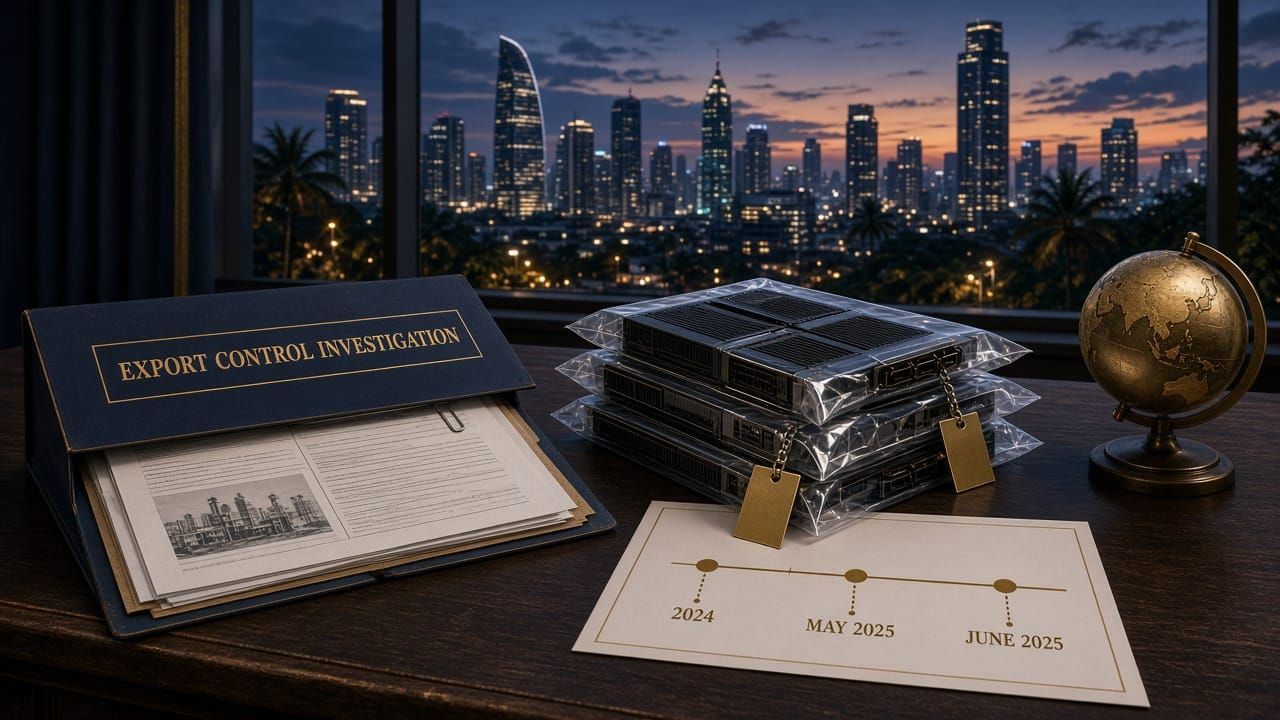
- Timeline: per the joint statement, Commerce opened an export-control investigation into Megaspeed in 2024, asked Nvidia for its sales records in May 2025, and Nvidia put Megaspeed on its internal no-sell list in June 2025.
- On-site check: in June 2025, Bureau of Industry and Security agents and Singaporean law enforcement conducted an end-use check at Megaspeed and interviewed its CEO, the statement says. The Justice Department then took the lead on the criminal investigation.
- No charges announced: the statement promises to pursue any criminal conduct that may have occurred, but announces no charges against Megaspeed.
- Track record: the departments say 17 defendants in six investigations have been charged with smuggling semiconductors under the Trump administration.
Joint Statement from Department of Commerce and Department of Justice on Megaspeed Investigation. pic.twitter.com/aAdtN9aDfF
- U.S. Department of Commerce (@CommerceGov) November 17, 2026
Important Details and Numbers
- The statement: posted by Commerce on X at 9:31 PM CT Monday, November 16, and dated November 17 on the Justice Department's site (press release 26-1365).
- Not blacklisted: Politico reports the government has still not added Megaspeed to the Entity List. Axios reported last week that Treasury Secretary Scott Bessent pressed Commerce Secretary Howard Lutnick on that point; Commerce called that account false.
- Critics: the Council on Foreign Relations' Chris McGuire wrote on X that "the facts here just don't add up" and that the statement does not explain why Commerce did not cut Megaspeed off from chips, CNBC reports.
- Espionage allegations: outlets have reported that a former Megaspeed executive linked to Huang is suspected of spying for China. Singapore's Ministry of Home Affairs said she was not investigated for espionage, and CNBC reports the Justice Department has reached no conclusion. These remain allegations.
- Same day: Commerce's Bureau of Industry and Security also issued a rule to restrict remote access to advanced U.S. computing including through data centers in third countries, CNBC reports.
- What was checked: the timeline and quotes were confirmed against the joint statement on justice.gov. The blacklist and reaction details come from Politico, Axios and CNBC. The Post's full article is behind a paywall and was not reviewed beyond its opening.
Why It's Here
Export controls only protect American technology if they are enforced consistently, and a public statement is not the same as an indictment or a listing. The Sovereignty Ledger favors transparency from agencies that wield this kind of power, and this case raises a fair question the statement leaves open: why a company under investigation since 2024 is still not on the government's own blacklist.
Disclosure: This is an AI-generated summary and analysis of another author’s work, produced under the AI Use Policy. All rights to the original belong to its author; read the original via the link at the top. To request removal, use the site’s contact link.
Get The Sovereignty Ledger by email
Free. One essay at a time. Unsubscribe whenever.
Get the next essay by email
Free. One essay at a time. Unsubscribe whenever.